Cardiologia Croatica
Istraživački asistent časopisa
Istraživački asistent časopisa
Istraživački asistent časopisa
Istraživački asistent časopisa
David M Shavelle
Summary: Recent years have seen major advances in the evaluation and treatment of patients with coronary artery disease. These include assessment of novel biomarkers and imaging methods for patients at risk for coronary artery disease, care of patients with ST-segment elevation myocardial infarction, a novel device to treat medical refractory angina, use of non-statin lipid-lowering agents, a better understanding of the risks and benefits of longterm dual antiplatelet therapy and the use of the newer antiplatelet agents. This article summarises research related to coronary artery disease published in Heart in 2014 and 2015, within the context of other major cardiovascular journals.
Alenka Kmecl, Breda Barbič-Žagar, Polona Knavs Vrhunec
Summary: High blood pressure has been identified as the leading risk factor, among 67 studied, for death and disability. Blood pressure control is still far from what would be necessary to reduce the cardiovascular risk. The treatment of hypertensive patients remains a challenging issue in daily clinical practice. The reduction in cardiovascular events with perindopril supports the concept of cardiovascular protective effects of perindopril beyond blood pressure lowering. Effective blood pressure control, as demonstrated in clinical studies with Krka’s perindopril and its fixed-dose combinations with indapamide and amlodipine, together with good tolerability and convenient once-daily dosing, have a positive impact on patients’ adherence to the treatment – which is a crucial step towards reaching the blood pressure targets.
Šime Manola, Nikola Pavlović
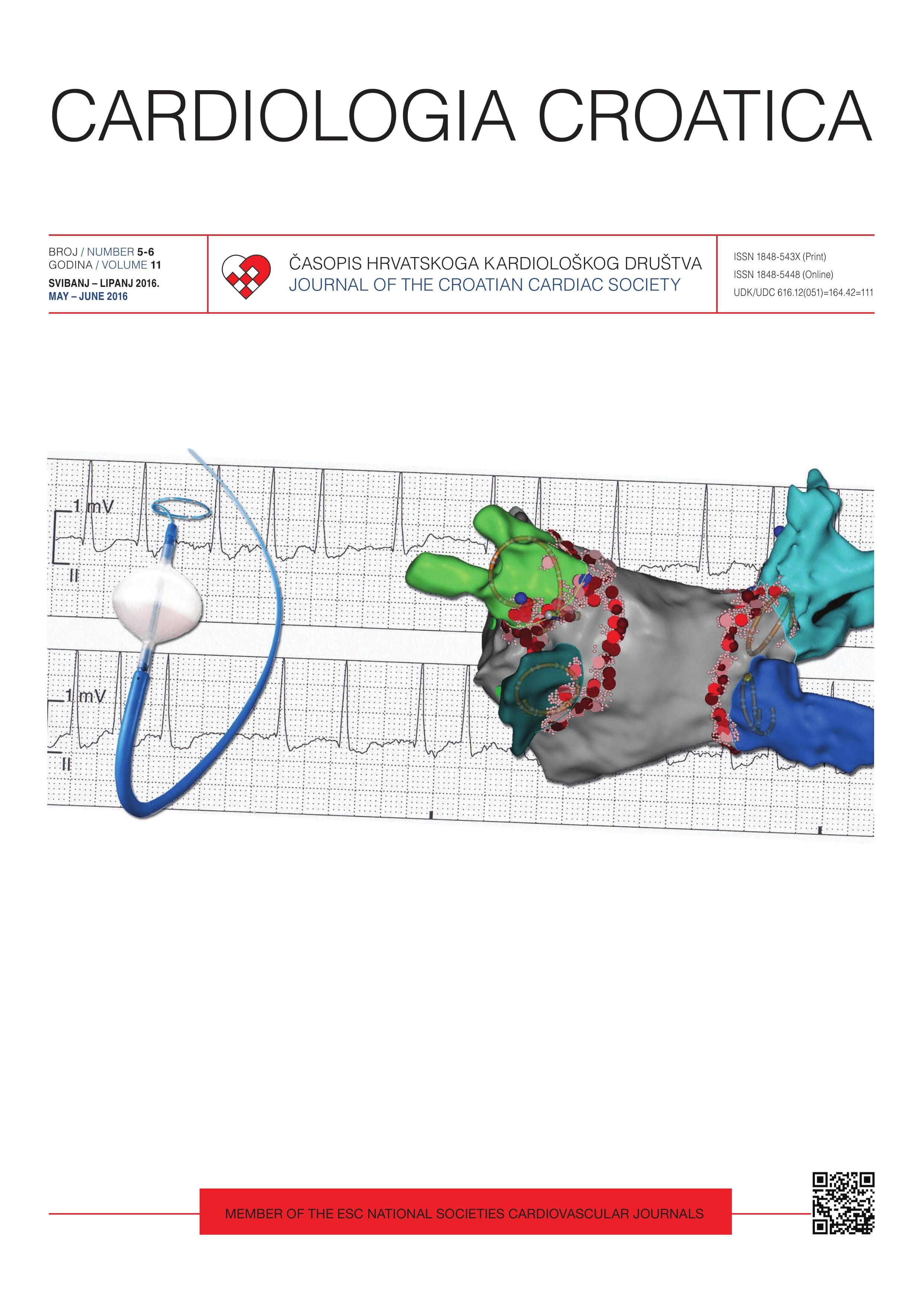
Atrial fibrillation (AF) is the most common persistent arrhythmia in the general population, with a prevalence of about 1-2%. It is believed that about 5-6 million people in Europe suffer from AF, and that number is increasing due to the aging of the population and lifespan extension. Although we do not currently have accurate epidemiological data or a registry in Croatia, assuming that the prevalence is the same as in Europe, we can estimate 40-50000 people suffer from AF in Croatia (1). Atrial fibrillation is associated with increased total mortality and morbidity and risk of stroke and heart failure. In addition to morbidity and mortality effects, AF represents a large socioeconomic issue due to the financial burden of treatment, rehabilitation, sick leave, and early retirement. For example, in Germany in 2006 the treatment costs alone for patients with AF at the national level amounted to almost 700 million euros. Due to the above, early diagnosis and adequate treatment are extremely important in patients with AF (2, 3). AF treatment focuses primarily on reducing the risk of stroke and mortality as well as symptom reduction in the patient. Currently, only anticoagulation therapy has been proven to reduce total mortality through stroke risk reduction. Symptom reduction in the form of frequency or rhythm control has not yet been unambiguously shown to affect mortality (4, 5). The AFFIRM study that compared maintenance of sinus rhythm and frequency control did not find any effect of sinus rhythm maintenance on mortality reduction. However, consequent analyses showed that sinus rhythm was a predictor of lower mortality, and that increased mortality was caused by the proarrhythmic effects of antiarrhythmic drugs and premature cessation of anticoagulation therapy in patients with sinus rhythm (6, 7). Pulmonary vein isolation for atrial fibrillation was developed as a way to maintain sinus rhythm without using antiarrhythmic drugs, and studies have consistently shown it to be superior in comparison with antiarrhythmic drugs for certain patient groups. Point-by-point radiofrequency ablation using X-ray imaging was developed initially, but it has been improved over the years with the development of 3D mapping systems and new irrigation catheters (8). Additionally, new technologies have appeared on the market several years ago (cryoablation, cryoballoon ablation, multielectrode catheter ablation, lasers, ultrasound, etc.) that have shown results similar to radiofrequency (RF) ablation. Although pulmonary vein isolation has been shown to be superior in maintaining sinus rhythm in comparison with antiarrhythmic drugs, studies have yet to find any effect on mortality – although we hope that studies will answer this question in the future (9). ## The situation in Croatia As stated above, an estimated 40-50000 people suffer from AF in Croatia. This is a serious public health and economic problem. Because there are no accurate data, in 2016 the Working Group on Arrhytmias and Cardiac Pacing of the Croatian Cardiac Society started the Atrial Fibrillation Registry that will initially cover part of the population (hospitals) and is planned grow into a national AF registry in the future that would provide correct data on patient numbers, treatment, and socioeconomic impacts. In the domain of medication therapy, primarily anticoagulation therapy, novel oral anticoagulant drugs have recently appeared on the market in Croatia and have demonstrated themselves comparable to or better than the gold standard warfarin therapy. Although use of these drugs is widespread in the European Union, since they are either not covered by insurance or incur additional fees these drugs are currently only available to a small number of patients in Croatia. Croatia also belongs to the group of countries with a large number of patients using warfarin that do not have adequately regulated international normalized ratios (INR). The question remains whether there is a need for standardization in educating/monitoring patients using anticoagulation therapy, i.e. opening clinics/polyclinics for AF and anticoagulation therapy. As to interventional treatment (pulmonary vein isolation), there has been great progress in Croatia over the past few years. The first pulmonary vein isolation procedures were performed in 2009. Today, pulmonary vein isolation is performed in five centers, of which three perform over 100 such ablations annually. Almost all globally available technologies are in use, with RF ablation being the most common method and amounting to 85% of all pulmonary vein isolation procedures performed in 2015. Last year, a total of 446 pulmonary vein isolation procedures was performed (**Figure 1**), which is 100 per million inhabitants. These numbers mean the performance of Croatian centers is comparable to centers in neighboring countries such as Hungary, Austria, and Slovakia (**Figure 2**). The Working Group for Arrhythmia has also started the Croatian and international pulmonary vein isolation registry this year, which currently includes 8 centers from the region. Figure 1. The number of ablations for atrial fibrillation in Croatia. Figure 2. The situation regarding ablation for atrial fibrillation in Europe (the total ablation rate per million inhabitants). Just like in the rest of the world, there has been great progress in the treatment of patients with AF in Croatia. The success rate of ablation therapy for paroxysmal atrial fibrillation and short-term persistent atrial fibrillation (<1 year in duration) is already rising to as much as 90% at one-year follow-up in high-volume centers. Ablation therapy for long-term persistent atrial fibrillation has not been nearly as successful, despite the employment of different strategies of ablation therapy. Additionally, accurate verification of results requires further efforts and investments into national registries, as well as standardization in treatment and follow-up for these patients. In conclusion, ablation therapy has, over a short period of time, become the standard treatment in the Republic of Croatia, and the number of procedures being performed is now at the level of Central European countries.
Muhammad Jawad-Ul-Qamar, Paulus Kirchhof
Summary: Atrial fibrillation continues to attract interest in the cardiovascular community and in Heart. Over 60 original research and review papers published in Heart in 2014–2015 cover various aspects of atrial fibrillation, from associated conditions and precipitating factors to new approaches to management. Here, we provide an overview of articles on atrial fibrillation published in Heart in 2014–2015, highlighting new developments, emerging concepts and novel approaches to treatment.
Eduard Margetić, Željko Baričević
Summary: Cardiovascular diseases are, despite positive trends and recent treatment advances, still the most common cause of death in the Republic of Croatia, mostly due to coronary artery disease. Croatia has every right to pride itself on the fact that patients with coronary disease are provided with modern, up to date and high-quality care comparable to more developed countries and wealthier healthcare systems. At the same time, the cardiovascular care in certain regions of Croatia is not at this level due to geographical, financial, and personnel limitations. There are multiple prerequisites for improving patient care, including the need for systematic and continuous efforts in prevention, diagnostics, and treatment. Starting with educational measures for population at-risk (through public-health campaigns promoting a healthy lifestyle) and optimizing the education of healthcare providers at the primary level, the reorganization of the healthcare system should work towards achieving availability and proper use of non-invasive diagnostic methods, unlimited access to appropriate medications, better organization of primary percutaneous coronary intervention network with reduced delays in revascularization, fully equipped interventional laboratories with improved working conditions for intervention teams, reduction of the waiting lists for cardiac surgery revascularization, and high-quality epidemiologic monitoring.