Cardiologia Croatica
Istraživački asistent časopisa
Istraživački asistent časopisa
Istraživački asistent časopisa
Istraživački asistent časopisa
Mario Ivanuša, Kristina Narančić Skorić, Srećka Glavaš Vražić, Dubravka Kruhek Leontić, Marija Heinrich, Lidija Mažuran Brkljačić, Gabrijela Ćurić, Goran Krstačić
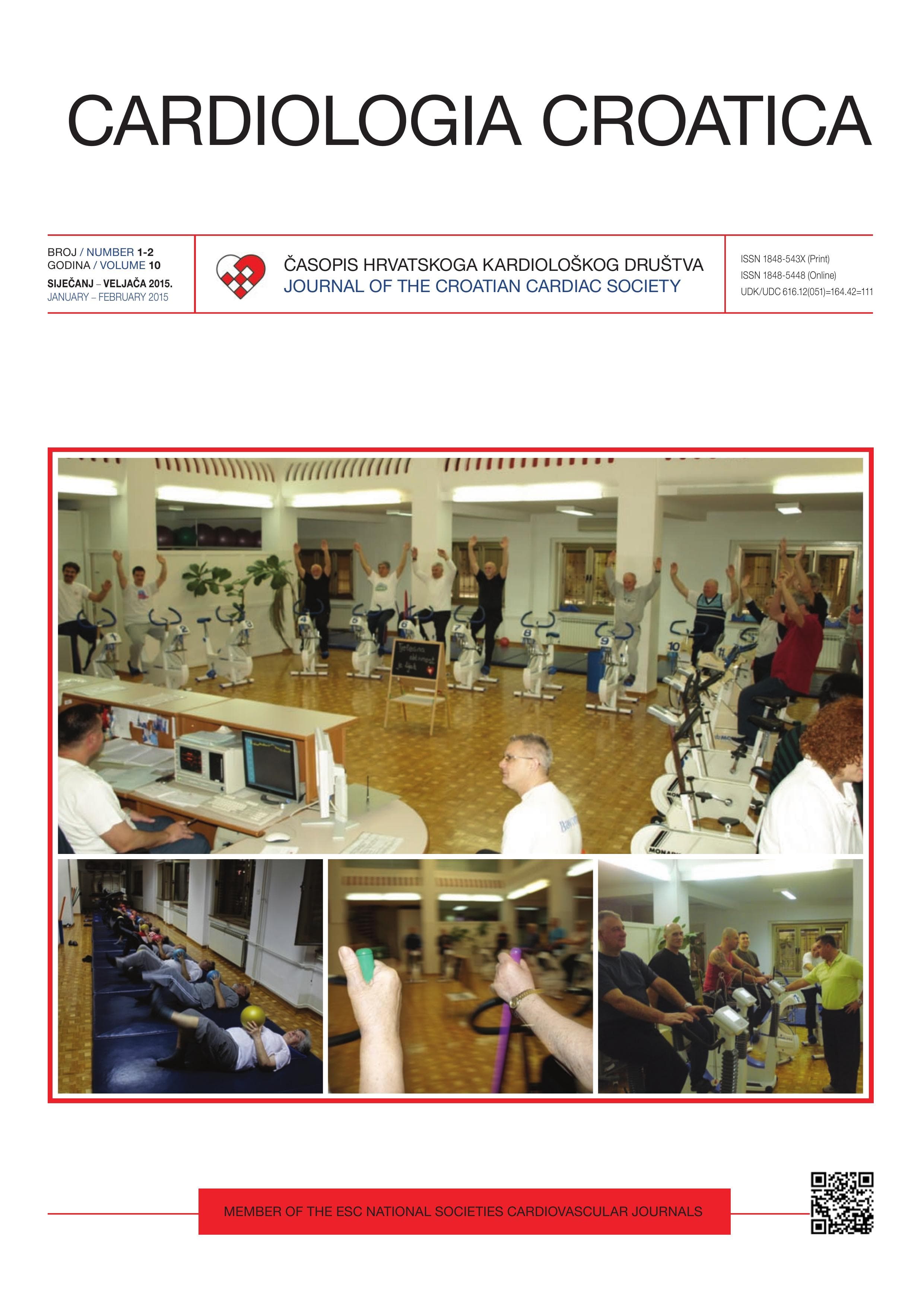
Cardiovascular rehabilitation is a part of cardiologic treatment that is performed in specialized hospital or outpatient centers by a team of medical personnel using an interdisciplinary and transdiciplinary approach. Cardiovascular training with telemetric electrocardiogram monitoring under the supervision of a cardiologist, full non-invasive diagnostic testing, psychodiagnostics and psychological counseling, patient education, and non-pharmacological measures coupled with typical medication treatment are all integral components of cardiovascular rehabilitation programs. This article describes the organization of outpatient cardiovascular rehabilitation in the Republic of Croatia, which is a effective, safe, cost-effective procedure that can be tailored to the patient and reduces mortality, increases functional capacity, restores work fitness and work capacity, and improves quality of life.
Jozica Šikić
Heart failure (HF) is a disorder in the structure or function of the heart that prevents it from maintaining adequate oxygen supply to other tissue. It manifests with symptoms and signs of damage to almost all target organs. The most common cause is damage of the systolic function of the left ventricle, but causes include disrupted diastolic function, valvular diseases, pericardial and endocardial diseases, and heart rhythm disorders. The diagnosis of HF can be established using both invasive and non-invasive techniques. The goal of HF treatment is to reduce the symptoms and signs of the disease, reduce rehospitalization, and improve the quality and length of the patient’s life. Three neurohormonal antagonists play a key role in the treatment: angiotensin-converting enzyme inhibitors (or angiotensin receptor blockers), beta-blockers, and mineralocorticoid receptor antagonists. Refractory HF in the terminal phase can be treated with heart transplants and cardiac support pumps, which can be uni- or biventricular and either temporary or permanent.
Maja Strozzi, Margarita Brida, Darko Anić
Due to the growing number of patients with adult congenital heart disease (ACHD), although their exact number and distribution in Croatia is not yet known, monitoring and treating these patients in specialized centers has become a necessity. Their number is estimated at 12 000, and in most cases these patients will require one or more surgical procedures due to complications later in life. The recommendations of the European Society of Cardiology include guidelines on the necessary number of specialized centers and their organization. Organization of such a center has begun in the Zagreb Clinical Hospital Center. This article describes the first steps being taken, which include setting up a clinic for ACHD, regular multidisciplinary councils, formation of a patient registry, and first steps towards educating the cardiologic community. A large number of patients were examined in the Center recently, providing insight into the specific problems in this patient population; we will present three cases here. The first is a woman with a surgically repaired tetralogy of Fallot but with an improperly diagnosed and treated case of arrhythmia, which can lead to serious clinical deterioration. The second patient is a woman with a case of corrected transposition that went undiagnosed due to a lack of experience on part of the cardiologist. Although the patient has not experienced significant difficulties, they are expected in the future, making a correct diagnosis extremely important. The third case is a typical ACHD patient, a woman that had undergone numerous surgeries in childhood in a constant search for a long-term solution, which in this case was a non-surgical valve replacement at aortic position. This overview also outlines specific challenges faced when treating young people who put especially high value on the quality of life.
Jasna Cmrečnjak, Marin Kursar
We are witnessing increasingly frequent cases of acute coronary syndrome in younger patients, or in patients who did not present the typical risk factors. Most studies define younger patients as persons under 45 years of age. Such patients are typically diagnosed with acute myocardial infarction (AMI) with normal coronary arteries, i.e. the coronary artery does not show intraluminal anomalies (strict definition) or with a smaller artery stenosis but hemodynamically insignificant (in most cases <30% stenosis). A recently published study (APPROACH) determined the prevalence of AMI with normal coronary arteries was 2.8% in patients who underwent coronary angiography for AMI. Differential diagnosis of such acute coronary events includes myocarditis, stress cardiomyopathy, and Takotsubo syndrome. There is no single explanation for the origin of AMI with normal coronary arteries, but a few possible mechanisms have been suggested: latent atherosclerosis, vasospasm, thrombosis and hypercoagulability, embolization, and inflammation. We differentiate between acquired and inherited thrombophilia syndrome. In this report, we will describe a link between hereditary forms of trombophilia (a mutation of factor V Leiden, prothrombin gene mutation, deficiency of protein C and protein S, antithrombin deficiency, and mutations in the gene for glycoprotein plasminogen activator inhibitor-1) and acute forms of cardiovascular disease.
Peter C Kahr, Gerhard-Paul Diller
This Almanac summarises important congenital heart disease articles published between 2012 and 2014 in Heart and other major cardiac journals. It highlights what the authors perceive to be highly relevant articles in the field. While the aim was to provide a comprehensive overview of the area, a focus on certain areas of interest was required. The selection is, therefore, by necessity a subjective one.